




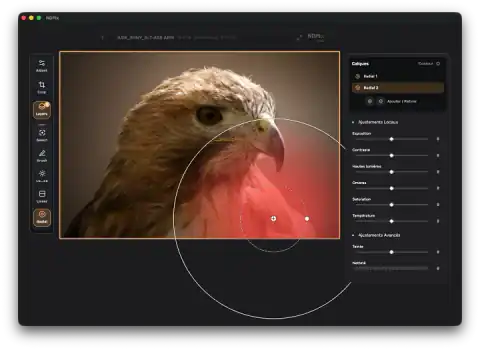


Photo Editor

Cameras

  • Photo Editor
Nikon D810
Nikon Full Frame

Nikon D810

  • Year 2014 · Full Frame

The Nikon D810 established itself as one of the most versatile DSLR cameras for professionals thanks to its 36.3MP full-frame sensor that dispenses with the low-pass filter (OLPF). This feature, combined with the EXPEED 4 processor, allows for extreme sharpness and exceptional dynamic range, ideal for landscape and studio photography. In addition, it stands out for offering a native ISO of 64, the lowest at the time for a DSLR, which guarantees incredibly clean images with rich tonal transitions even in bright light conditions. Its robustness and performance are complemented by a redesigned shutter mechanism that minimizes internal vibrations, along with a high-precision 51-point autofocus system. Unlike its predecessors, the D810 is significantly improved in video, enabling Full HD recording at 60p with clean HDMI output, and offering class-leading battery life (up to 1,200 shots), making it a reliable all-round work tool.

View details
Nikon DL (Cancelled)
Nikon 1 inch

Nikon DL (Cancelled)

  • Year 2016 · 1 inch

The Nikon DL series was an ambitious bid to dominate the premium compact market through three variants equipped with 1-inch sensors: the DL18-50, featuring a class-leading f/1.8 ultra-wide-angle lens; the DL24-85, designed for everyday use with an impressive 1:1 macro function; and the DL24-500, a "superzoom" version for capturing long-distance action. All models shared high-end technologies such as the EXPEED 6A processor, a blazing-fast hybrid autofocus system, 20 fps continuous shooting, and 4K UHD video recording, all within a user interface familiar to DSLR owners. However, the project was permanently canceled in February 2017, one year after its announcement, without ever hitting the shelves. The decision was driven by critical development delays caused by issues with the image processing chip and an unexpected increase in production costs. Faced with a compact camera market that was rapidly shrinking due to the evolution of smartphones, Nikon determined that the DL series would no longer be profitable, making it one of the most famous cases of "vaporware" in photography history. ------- Official Announcement: Cancellation of the Launch of the Premium Compact Camera DL Series / February 13, 2017 TOKYO - Nikon Corporation announced today that sales of the highly anticipated DL series of premium compact cameras—the DL18-50mm f/1.8-2.8, DL24-85mm f/1.8-2.8, and DL24-500mm f/2.8-5.6—will be canceled. The DL series was originally planned for release in June 2016. However, after issues were identified with the image processing integrated circuit, the launch of the three cameras was indefinitely postponed. Since then, everyone involved has worked diligently to develop products that will satisfy our customers. However, the decision has been made to cancel sales of the DL series due to concerns about its profitability, considering the increased development costs and the anticipated decrease in sales due to the slowing market. We sincerely apologize to everyone affected by this decision, especially customers who have waited so long for the cameras to be released, retailers, and others whose businesses will be impacted, for any inconvenience this decision may cause.

Nikon 1 AW1
Nikon 1 inch

Nikon 1 AW1

  • Year 2013 · 1 inch

The Nikon 1 AW1 stands out for being the only interchangeable lens camera in the world designed to be completely waterproof (up to 15 meters) and drop resistant without the need for an external case. Equipped with a 1-inch 14.2MP sensor, it offers an extremely fast hybrid autofocus system and burst shooting up to 60 fps, making it ideal for action and water sports. Its most important features include its robust stainless steel construction, hermetic sealing reinforced with O-rings, integrated GPS with depth gauge and compass, and the ability to interchange specific AW series lenses that maintain the system's watertightness in extreme cold and wet conditions.

Nikon D800E
Nikon Full Frame

Nikon D800E

  • Year 2012 · Full Frame

The Nikon D800E is a specialized version of the D800 that stands out mainly for the elimination of the effects of the low-pass filter (anti-aliasing). This technical modification allows the 36.3MP sensor to capture even greater sharpness and detail, making it a cult camera for landscape, architectural and studio photographers looking for the highest possible resolution. However, this improvement comes with a higher risk of moiré appearing in certain repetitive patterns, requiring a more careful post-processing workflow. As for the rest of its specifications, it maintains the professional robustness of its sister: a weather-sealed magnesium alloy body, a 51-point focusing system and a class-leading dynamic range. It's a heavy camera (900g) and lacks modern wireless connectivity or articulating screen, but its image quality remains outstanding even against current standards. It is, in essence, the ultimate tool for those who prioritize pure detail over versatility or speed of fire.

Nikon D800
Nikon Full Frame

Nikon D800

  • Year 2012 · Full Frame

The Nikon D800 is a landmark full-frame DSLR thanks to its 36.3MP sensor, offering exceptional resolution ideal for landscape and studio photography. Its robust magnesium alloy body is weather-sealed, making it a professional-grade tool capable of withstanding demanding conditions. In addition, it stands out for its optical viewfinder with 100% coverage, a highly precise 51-point autofocus system and the inclusion of microphone and headphone ports, something that at the time positioned it as a very solid option for Full HD video production. Although it is a heavy camera (900g) and its shooting burst is somewhat limited for sports (4 fps), it is still highly valued for its dynamic range and the sharpness it captures. It has a double card slot (SD and CF) and excellent ergonomics with dedicated controls, allowing agile and manual handling. It is, in essence, a "beast" of technical detail that, despite not having modern wireless connectivity or an articulated screen, maintains an image quality that competes worthily with much more recent models.

Nikon D2X
Nikon APS-C

Nikon D2X

  • Year 2004 · APS-C

The Nikon D2X is Nikon's classic pro DX DSLR: a rugged body, 12.2 MP CMOS sensor, fast 5 fps shooting (up to 8 fps in High-Speed Crop), and full Nikon F-mount lens compatibility.

Nikon D6
Nikon Full Frame

Nikon D6

  • Year 2020 · Full Frame

The Nikon D6 is a professional full-frame DSLR designed to offer maximum speed and reliability in sports and action photography, standing out for its 20.8MP sensor, 14 fps bursts and an advanced 105-point cross-type focusing system. This model stands out for its robust construction with environmental sealing, illuminated buttons for night work and an exceptional autonomy of up to 3,580 shots, also integrating advanced connectivity through Wi-Fi, Bluetooth and high-speed Ethernet. Although it lacks a built-in image stabilizer and its 1.2kg body is considerably heavy, it is still an elite tool for professionals who require foolproof performance in extreme conditions.

OM System OM-3 Astro
OM System

OM System OM-3 Astro

  • Year 2026

The OM System OM-3 Astro is positioned as a precision tool designed specifically to capture light from the cosmos that conventional cameras ignore. Its most disruptive feature is the hardware modification to its IR cut filter, optimized to allow 100% transmission of the alpha hydrogen line (H$\alpha$). This allows the reddish tones of the emission nebulae to be recorded with deep clarity and saturation, a technical detail that would normally require modifying the sensor externally, losing the warranty and sealing of the body.For the technical photographer, this camera integrates computational functions that simplify traditionally complex processes. Its in-camera Stackingsystem stands out, capable of combining up to 12 shots to generate 50 MP files with drastically reduced digital noise, automatically compensating for the movement of the stars. Additionally, the introduction of the Body Mount Filters allows light pollution suppression to be applied even on ultra-wide-angle lenses that do not support front filters, maintaining the integrity of the system thanks to its IP53sealing certification.In terms of its uses, it is the definitive choice for landscape and deep sky astrophotography, allowing you to capture the Milky Way and stellar objects with a professional level of detail without always depending on heavy equatorial mounts. It is also ideal for photography expeditions in extreme conditions, such as capturing the northern lights in sub-zero climates. However, due to its extreme sensitivity to red, it is a niche tool: while in the stars it is unbeatable, in social or portrait photography skin tones would require extensive color correction, so its natural habitat is, without a doubt, the darkness of the night.

Recommended Reading