How to Transform Your Photos with the Fotodiox TLT ROKR Tilt-Shift Adapter
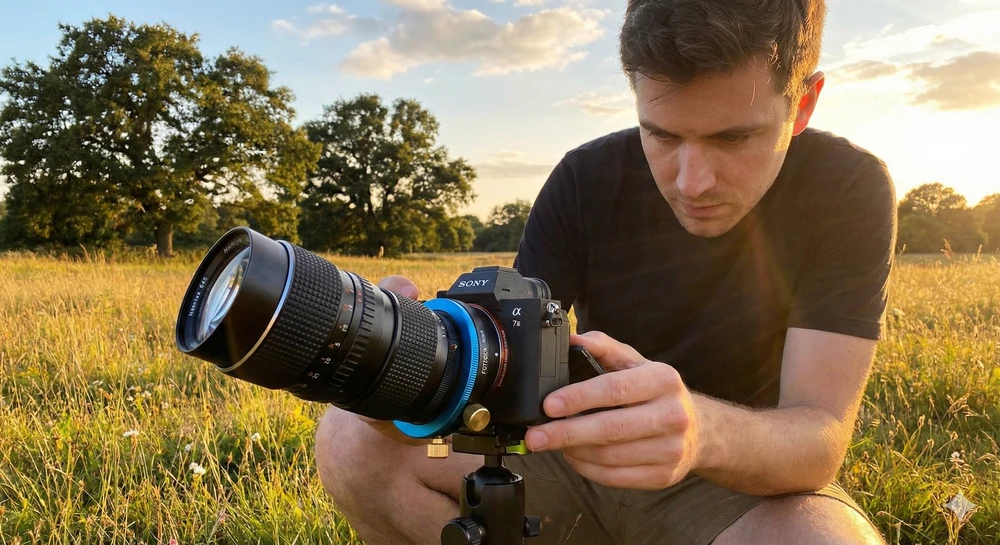
If you’ve ever photographed a building and felt the frustration of seeing it "lean" backward, or if you’ve dreamed of achieving that iconic "miniature" look in urban landscapes but recoiled at the price of native Tilt-Shift lenses, the Fotodiox TLT ROKR adapters are the solution you’ve been looking for.
These adapters are more than just metal rings to mount a lens; they are precision-engineered tools that unlock creative capabilities once reserved for large-format photography or multi-thousand-dollar lenses.
What Makes the TLT ROKR System Special?
While most adapters are passive components, the TLT ROKR features an articulated mechanism that allows for two fundamental movements:
- Shift for Architecture The 10mm shift capability (up, down, or sideways) allows for perspective correction. By shifting the lens instead of tilting the camera, you can keep the sensor plane parallel to the building. This eliminates perspective distortion directly in the shot, avoiding the resolution loss often caused by post-production corrections.
- Tilt for Focal Plane Control With up to 10 degrees of tilt, you can apply the Scheimpflug Principle. This allows you to:
- Maximize Depth of Field: Keep everything sharp—from a flower inches away to mountains in the distance—even at medium apertures.
- Selective Focus: Create a narrow slice of sharpness surrounded by extreme blur (the famous "toy model" or "miniature effect").
The Magic of Medium Format on Mirrorless
The best-kept secret of these adapters is their ability to use medium format lenses (such as Mamiya 645 or Pentax 645) on Sony E, Nikon Z, or Fuji X bodies.
- Why is this an advantage? Medium format lenses project a much larger image circle than a Full Frame or APS-C sensor requires. This means you can shift the lens aggressively without encountering vignetting or loss of sharpness in the corners, effectively utilizing the "sweet spot" of the optics.
Who Is This Tool For?
- Architectural Photographers: Those who need perfect vertical lines without investing in expensive first-party TS-E or PC-E lenses.
- Landscape Photographers: Those seeking absolute sharpness throughout the frame without always relying on focus stacking.
- Content Creators: Those looking for a unique, organic visual aesthetic that software still cannot convincingly replicate.
Conclusion: Is It Worth It?
If you already own high-quality vintage glass or are willing to explore the second-hand medium format market, the Fotodiox TLT ROKR is likely the best cost-to-creativity investment you can make. It’s robust, precise, and, above all, it brings back the fun and manual control to the photographic process.
Pro Tip: When using these adapters, remember that control is 100% manual. Take advantage of your mirrorless camera’s Focus Peaking and Focus Magnifier to nail the sharpness exactly where you want it.