The Audiovisual Crisis Is a Business Model Crisis (Not a Sector Collapse)
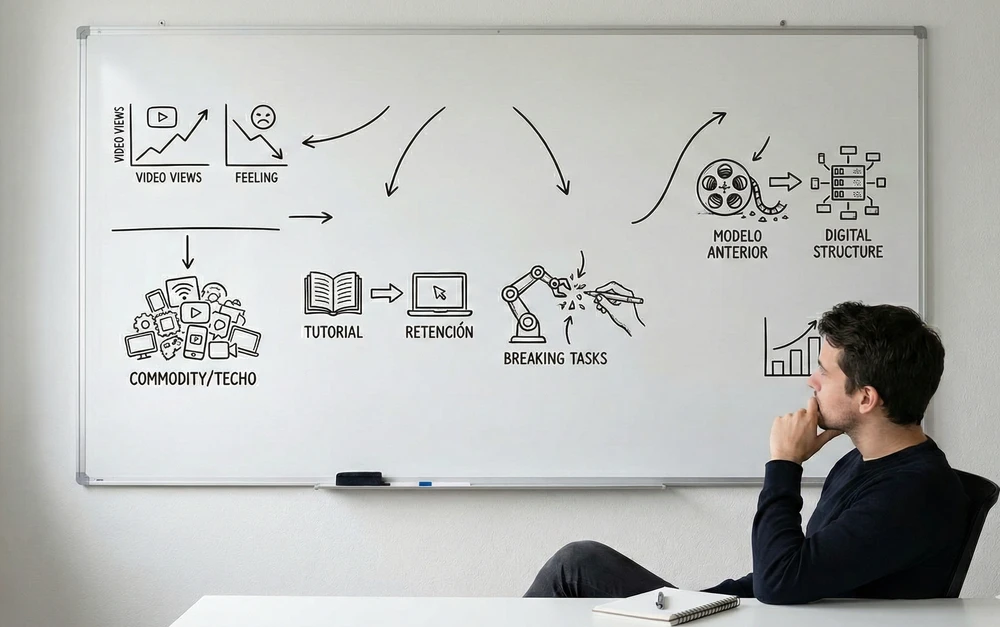
A large part of today’s conversation about photography and video starts from a flawed assumption: people see real signs of stress in certain formats, services, and career paths, then jump to the conclusion that audiovisual work itself is dying. That conclusion is too broad.
What is under pressure is not the need for visual content. What is under pressure is a specific way of capturing value in the audiovisual market: one built on high technical barriers, obvious hardware advantages, and more predictable distribution dynamics.
This distinction is not academic. It directly changes how professionals should position themselves, which services are likely to remain profitable, and why some careers slow down while others expand.
The mistake: using old metrics to judge a new phase
When certain educational formats lose traction, when camera launches create less excitement, or when legacy services become less profitable, the feeling of decline makes sense. The problem begins when those signals are treated as proof that the entire audiovisual sector is shrinking.
In practice, many of those signals point to something else: value is moving. Some activities that used to concentrate attention, margins, and status no longer occupy the same position. Meanwhile, audiovisual use cases that once looked secondary are becoming central in many businesses.
Put simply: this is not less audiovisual demand. It is a different value map.
There is no single audiovisual market anymore
One productive way to understand the moment is to stop treating “the audiovisual industry” as a single homogeneous market. Today, multiple work models coexist, each with different economics and expectations.
High-impact production
This segment remains real and important: premium campaigns, ambitious brand pieces, film, television, and productions that require strong teams and specialized workflows. But it does not define total demand on its own.
Operational business content
A major portion of growth sits here: sales content, training assets, product communication, ads, customer support media, launches, and social distribution. Many companies are not buying “artwork”; they are buying a functional tool that helps achieve a concrete outcome.
Creator-led microbusinesses
Another expanding model is the solo creator or small team that produces, distributes, learns, and monetizes directly. This shifts the economics of the field: less dependence on large structures and more importance placed on strategy, consistency, and positioning.
When these worlds are blended into a single narrative, it becomes easy to say “everything is worse.” What actually changed is the composition of the market.
What became a commodity, and what became premium
Technical skill still matters, but in many niches it no longer functions as the dominant barrier to entry. Education is more accessible, tools are easier to use, and mid-to-high-tier hardware often performs well beyond what most projects really require.
That makes certain tasks more interchangeable when sold in isolation. Not because they are useless, but because more people can now execute them at a sufficient level.
At the same time, less replicable capabilities become more valuable:
- Diagnosing what content should be produced and why.
- Designing messages and narratives for a real audience.
- Prioritizing channels, formats, and publishing rhythm.
- Making creative decisions with business context in mind.
- Building sustainable production systems instead of one-off pieces.
Mature hardware is part of this story, but it is not the whole cause. The deeper shift is that the market rewards isolated execution less and rewards judgment, direction, and context more.
AI does not shrink audiovisual work. It redistributes labor and value
Artificial intelligence accelerates this transition. It compresses repetitive tasks, lowers the cost of basic output, and makes prototyping dramatically faster. That puts pressure on professionals who compete mainly on manual execution or operational speed.
At the same time, AI amplifies professionals who can direct a process well. With stronger judgment, they can test more options, build better proposals, iterate faster, and improve decision quality.
The real effect is not simply “AI replaces professionals.” The more useful reading is this: AI makes it easier to see which parts of the job were easily substitutable and which parts depended on vision, strategy, and judgment.
Audiovisual work is becoming infrastructure inside larger systems
For a long time, many careers were built around audiovisual work as an end in itself. Increasingly, however, photo and video function as infrastructure inside communication, sales, education, support, brand positioning, community building, and product systems.
This forces a shift in professional positioning. People who sell “I make photos and videos” compete in a category with stronger price pressure. People who sell a solution tied to outcomes enter a different conversation: growth, conversion, clarity, trust, retention, or authority.
This is not about abandoning craft. It is about placing craft inside a larger system where it creates measurable value.
How to reposition without fighting the market transition
Adapting does not require abandoning creative identity, but it does require changing how value is packaged and communicated. A few practical shifts matter:
- Define the problem you solve before listing the tools you use.
- Sell a process (diagnosis, production, distribution, iteration), not only deliverables.
- Use business language when working with companies and brands.
- Use AI to accelerate research, pre-production, and iteration without outsourcing judgment.
- Specialize by context (client type, industry, objective), not only by technique.
- Strengthen storytelling and direction, because aesthetics alone are easier to replicate.
These shifts do not remove competition, but they change the kind of competition. The question is no longer only who can execute a piece. It is who best understands the system where that piece must work.
A more useful reading of this moment
Calling the entire process “decline” may be emotionally understandable, but it is strategically misleading. If the diagnosis is wrong, the professional response will also be wrong.
A more useful reading is that audiovisual work has entered a maturity phase. There is more supply, more tooling, more channels, and more pressure. There is also more total demand, more use cases, and more room for professionals who can combine craft, judgment, storytelling, and business thinking.
The real question is no longer whether audiovisual work has a future. The real question is what kind of professional you will become inside this new value map.