Canon Turns Heads at CP+ 2026 with a Retro-Inspired Concept Camera
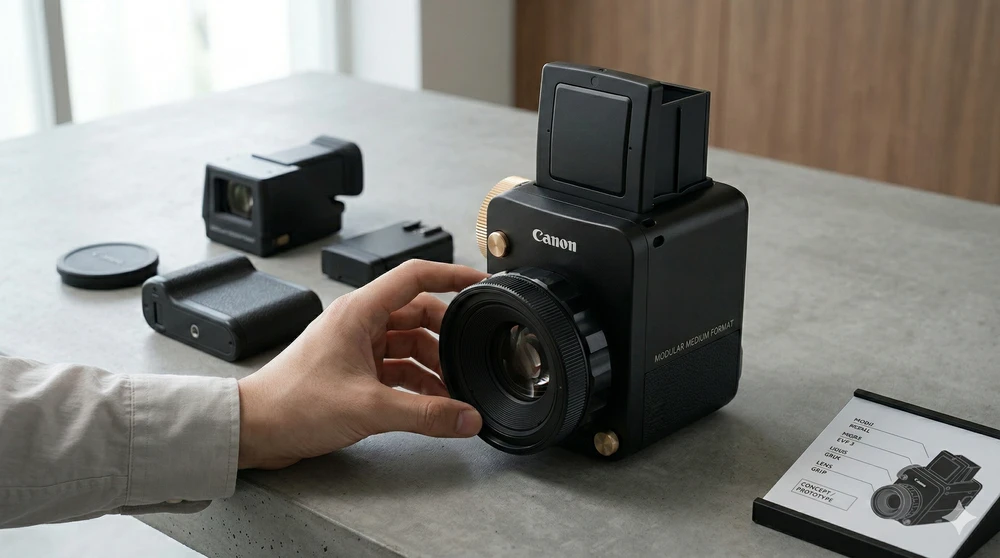
The CP+ 2026 photography trade show in Japan delivered one of the most talked-about surprises of the season: Canon unveiled a concept camera that pays homage to classic medium-format film cameras, built around a philosophy that embraces the analog world rather than running from it. This is not a confirmed commercial product — at least not yet — but it is a bold statement that has sparked genuine debate across the global photography community.
- Important note: The cover image was automatically generated by Artificial Intelligence (AI) from the original photographs. You can access the actual photos by clicking below where it says "Useful Links".
A Design That Looks Back to Speak About the Future
Canon's concept camera comes in two aesthetic variants: one with sharp, angular lines and a strong vintage character, and another with a cleaner, more modern boxy profile. Both share the same technical core and the same philosophical intent — to return photographers to a more deliberate, tactile, and contemplative shooting experience, as an antidote to the hyper-automated immediacy of today's cameras.
The influence of classic medium-format cameras — particularly iconic waist-level finders like those found on vintage Hasselblads — is unmistakable in both form and function. Instead of looking through a viewfinder at eye level, the photographer gazes downward into the camera, reclaiming a ritual that many consider almost meditative.
The Optical Magic of the Mirror System
The most fascinating element of this concept is its internal optical system. Light enters through a fixed lens and is redirected by two mirrors: the first bounces it upward, and the second projects it onto a special screen inside the waist-level viewfinder. This screen is designed to mimic the behavior of ground glass in analog cameras, reproducing that characteristic texture — with visible blur and bokeh — before the shutter is even pressed.
When the photographer operates a side lever to capture the image, the mirrors reposition and redirect light toward the sensor. Rather than recording the scene directly, the sensor captures the image as it appears projected on that intermediate screen. The result is an image with a natural diffusion and softness that emulates analog film aesthetics — accompanied by the satisfying mechanical "clack" of the lever, reinforcing the full sensory experience of the shot.
Technical Specifications of the Prototype
- Sensor: 1-inch, 6 megapixels
- Focus: Manual only
- Lens: Fixed (non-interchangeable)
- Viewfinder: Waist-level, with ground glass-simulating screen
- Display: Flip-up rear LCD for image review
- Connectivity: USB-C
- Autofocus: Not available
- Interchangeable lenses: Not available
Real Product or Marketing Move?
This is where the conversation gets more grounded. PhotoRumors, one of the most respected sites in the photography industry, approached the announcement with clear skepticism — noting that Canon has a track record of presenting eye-catching concepts at trade shows that never make it to retail shelves. Their read: this is a brand positioning play, a way for Canon to signal relevance and cultural awareness at a time when interest in analog photography, slow photography, and film aesthetics is surging — without committing to an actual product launch.
That said, even if this camera never reaches stores, its unveiling carries its own significance. It reveals how Canon is thinking about the future of the photographic experience, and what kind of photographer might crave something radically different from everything currently on the market.
Why This Concept Matters
In a market defined by high-resolution sensors, AI-powered autofocus, subject-tracking systems, and burst rates that can fire dozens of frames per second, this Canon concept deliberately goes the other direction: slowness, intention, controlled imperfection, and sensory engagement. It's a camera that forces you to think before you shoot.
For photographers who grew up shooting film, or for a younger generation drawn to lo-fi aesthetics and the analog revival, this proposal lands with genuine emotional resonance. Yes, the 6-megapixel resolution and the indirect capture through an intermediate screen represent real compromises in image quality. But the concept captures something many modern photographers feel they've lost — a physical and emotional connection to the act of making a photograph.
Final Thoughts
Canon's CP+ 2026 concept camera is, above all else, a conversation starter. It's an invitation to reflect on what we truly value in contemporary photography, and on where a historic brand might be heading when it chooses to look backward in order to imagine forward. If it ever reaches production, it will be a cult object. If it doesn't, it will have at least reminded us that experience matters just as much as resolution.