The Rebirth of the Compact Camera: Canon Redefines the Game for a New Generation of Creators
Who said compact cameras were dead? Apparently, not Canon. In fact, the company is making a strong bet on a resurgence, not with mere updates, but with a strategic vision that seeks to capture an entirely new generation of photographers and videographers. The narrative is clear: today's customers are not yesterday's; they are users with distinct demands, seeking tools that the ubiquitous smartphone, however good it may be, simply cannot offer.
This isn't just a hunch. We've seen how the demand for dedicated compact cameras has grown surprisingly. Models considered 'old,' like the PowerShot G7 X Mark III, still maintain considerable resale value, evidencing a latent market eager for specialized devices. New creators aren't looking for the nostalgia of 'grainy' images; they're looking for advanced capabilities and content creation tools that give them a distinct advantage.
Technological Innovation as a Fundamental Pillar
To meet this emerging demand, Canon is deploying an impressive technological arsenal, focusing on key areas:
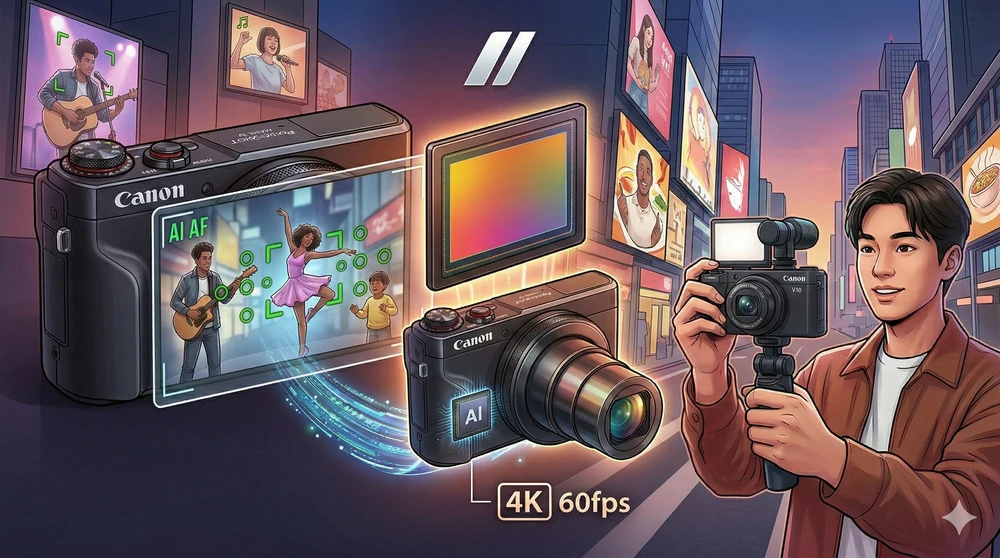
- Next-Generation Image Processing: Upcoming compact models, such as a possible PowerShot G7 X Mark IV, are anticipated to make a quantum leap in processing power. We're talking about a significantly faster processor than previous generations, a crucial element for enabling high-performance features. This includes 4K video at 60 frames per second and, most excitingly, Artificial Intelligence Autofocus (AI AF). Imagine the precision and subject tracking of high-end professional cameras, but in a device that fits in your pocket. This isn't just a speed improvement; it's a redefinition of how a compact camera can interact with the world.
- APS-C Sensors in Compact Bodies: One of the most anticipated advances is the integration of APS-C sensors into truly compact cameras, perhaps in the PowerShot V line. This would be a remarkable engineering achievement, offering superior image quality, extended dynamic range, and exceptional low-light performance—qualities previously reserved for much bulkier interchangeable-lens cameras. It's a clear challenge to the idea that 'bigger is better' when it comes to sensors.
- Advanced Optical Design: Achieving high image quality in small, lightweight bodies requires exceptional optics. Canon is utilizing advanced tools, such as virtual lens design, to optimize optical performance in simulated environments. This allows for the creation of compact, high-performance lenses without compromising quality, a critical differentiator from mobile photography.

Designed for Specific Uses and New Niches
Beyond specifications, Canon is adapting these innovations to 'new use cases.' For example, an evolution of the PowerShot V10 could offer improved 4K video, expanded connectivity, modular accessories, and weather resistance, making it the ideal tool for vloggers and content creators who need robustness and versatility. The development of an APS-C sensor compact with a deep grip is also rumored, clearly aimed at enthusiast photographers seeking premium quality in a portable format.
In summary, Canon's strategy for the compact camera segment is a total reinvention. It combines a clear vision for 'new customers' and 'new use cases' with the strategic application of cutting-edge processing, sensor, and optical technologies. With AI in autofocus, faster processors, and the possible inclusion of APS-C sensors, Canon aims not just to participate, but to lead the rebirth of the compact camera, offering specialized, high-performance devices that provide distinct value against smartphones and interchangeable-lens cameras. We are on the verge of a new era for portable photography and video.