Instagram in 2026: What Image Formats Generate the Most Reach?
You shoot in landscape. You've been doing it for years. You compose carefully, nail the light, the framing is yours. Then you open Instagram and the algorithm crops out the best part. It's not a minor issue — it's the central tension between photography as a craft and social media as a distribution channel. And in 2026, that tension has never been more demanding.
The Real Cost of Posting in Landscape
Over 90% of Instagram views happen on a mobile phone, in vertical. When you upload a 16:9 photo, the platform accepts it — but charges you a silent tax: your image takes up just a narrow strip of the feed, and Instagram fills the empty space with someone else's content. Your photo competes on the same screen with another image that, if it has more color or contrast, wins. The user scrolls past before your work ever had a real chance.
On top of that comes the biggest change of the past year: in 2025, Instagram eliminated the square grid and switched profiles to a 3:4 display ratio. Uploading in 4:5 or 1:1 can now appear cropped directly on your profile grid. For maximum control over how your feed looks, sticking to 3:4 is the safest choice — though if maximizing feed presence is the priority, 4:5 still delivers the most aggressive screen coverage, as long as you keep in mind how it will preview on the grid.
Which Format to Use and When
The logic is straightforward: always try the most vertical crop that preserves the essential visual information. 3:4 (1080 x 1440 px) first — it fits the new grid and takes up significant screen space. If the composition demands it, 4:5 (1080 x 1350 px) — still the format with the strongest feed presence. And only when there's no other compositional option, 1:1.
There's a critical technical detail photography forums repeat constantly: uploading at a higher resolution than recommended doesn't improve the image — it makes it worse. Instagram works with a maximum width of 1080 px; exceeding that triggers more aggressive compression that degrades sharpness. Exporting at exactly 1080 px wide, in sRGB color profile, with high export quality is what actually makes a difference. Also avoid screenshots and pay attention to edges — compression artifacts tend to appear most at image margins.
Practical Tips from Photographers Who've Been Through This
This is what the community has learned through trial and error:
- One landscape photo is two or three verticals. Shooting in horizontal with the mindset that you can extract two or three different vertical crops from that file maximizes the yield of each shot without forcing a change in how you shoot. More content, same effort.
- The white border as an honest solution. When a crop destroys the image, adding a white (or black) frame lets you publish at the correct ratio without losing any element. It's cleaner than automatic black bars and has become a recognizable aesthetic in many photography feeds.
- Carousels in "Mixed" mode. Instagram allows you to post landscape and portrait photos in the same carousel by enabling the "Mixed" option in the ratio selector, without external apps or forced crops. Ideal for series or stories where both orientations coexist.
- The outer 10% is a danger zone. Important elements — faces, text, logos — should not sit in the outer 10% of the image, as that area is most prone to automatic cropping and compression artifacts.
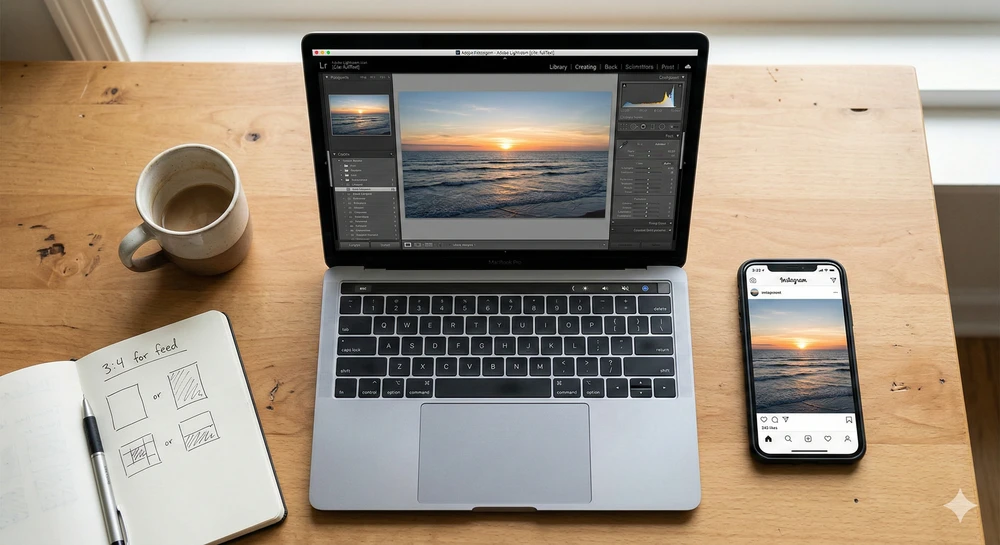
- Set the output crop before editing, not after. Establishing the output ratio at the start of your Lightroom editing workflow lets you adjust exposure, color, and retouching already in the final frame — no surprises at export time.
- Stories: safe zone in the center. A photo in 4:5 or 3:4 is already nearly compatible with Stories (9:16). The leftover margin top and bottom usually resolves by slightly opening the frame. If there's no room, the central area of 1080 x 1610 px is the safe zone where any important element should live.
The Most Important Change: Decoupling the Shot from the Post
None of this means you have to stop shooting in landscape. Around 70% of active Instagram photographers still shoot horizontal most of the time — and they're not disappearing from the feed. The key is mental: knowing when you shoot which part of the image will survive the crop. It's an editorial decision, not an artistic compromise. The same thing a photojournalist does when they know whether their image is going on the cover or in a side column.
In practice, the full workflow can be handled from your phone: an editing app to select the output ratio, add borders if needed, and export versions for feed and Stories in the same step. The key is building it into your regular publishing workflow, not treating it as a last-minute fix.
Summary
Situation Recommended Format Landscape photo with central subject 3:4 or 4:5, cropping the sides Landscape photo with edge information White border + 4:5 or 3:4 ratio Mixed series (landscape + portrait) Carousel in "Mixed" mode Adapting to Stories 4:5 base + minimal border expansion Image that can't be cropped 1:1 as a last resort The platform changes. The formats that work today may not be the same in six months — it already happened with the shift from the square grid to 3:4. What doesn't change is the principle: more screen space occupied, more chances someone stops scrolling.