How to ruin (or save) a Wedding with your Camera?
The Most Common Mistakes Wedding Photographers Make — and How to Avoid Them
There's an uncomfortable truth in wedding photography: many photographers aren't creating images — they're simply documenting that something happened. There's a huge difference between the two, and that difference shows in every gallery delivered.
After closely observing the work of several photographers at real weddings, these are the patterns that repeat over and over among those who don't rise to the occasion.
1. Standing Still and Shooting from the Same Height
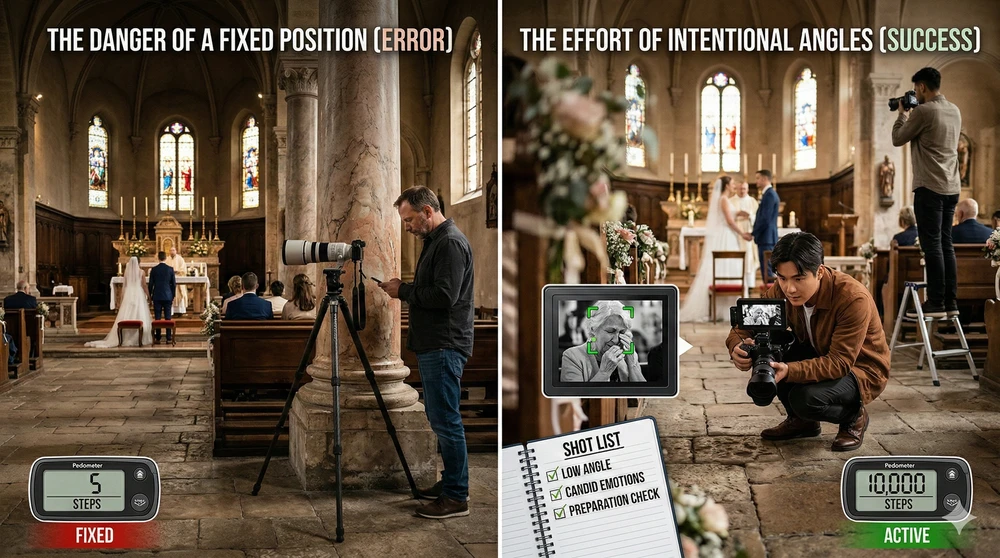
One of the most common mistakes is not moving. Photographers equipped with 70-200mm telephoto lenses plant themselves in one spot and wait for life to come to them. The zoom lens is a powerful tool, but it doesn't replace movement — it exists to reach places your feet can't get to in addition to actively moving around.
At a wedding you should be clocking your 10,000 steps. Anticipating moments, reacting, getting closer when it makes sense. Not to interrupt, but to be in the right angle before the moment peaks.
And if on top of that every shot was taken at the same height, the problem doubles. Getting on the floor to show the sky, finding a balcony, crouching to frame with elements in the environment... all of that requires physical discomfort. And that's exactly what separates a committed photographer from one who's simply "there." A good wedding photographer should look just as out of place physically as someone going all-in on the dance floor.
2. No Coordination, No Preparation, No Criteria
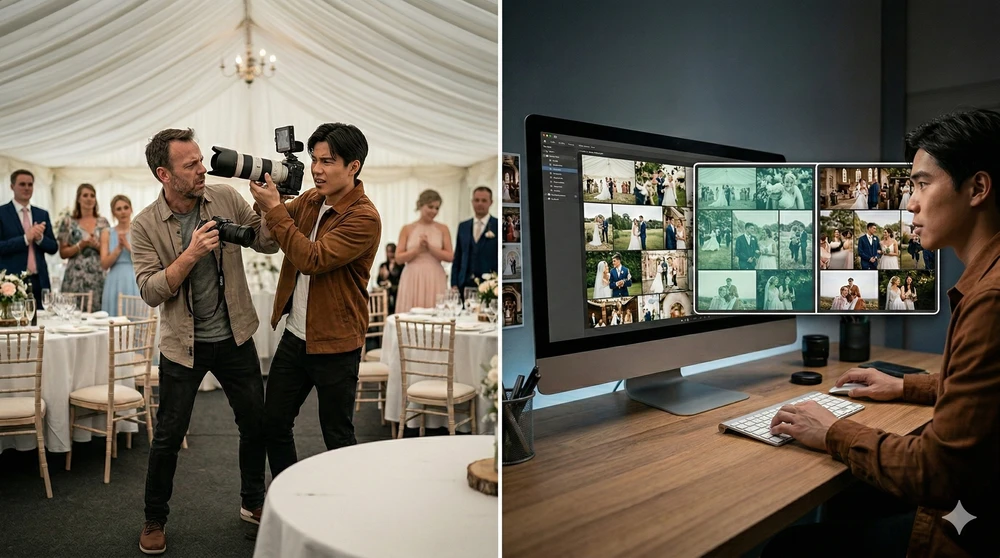
When there are two photographers or a mixed photo and video team, lack of coordination is a silent disaster. Without agreement on positioning or coverage, teams step on each other, duplicate angles, and miss irreplaceable moments. The solution is simple: define before the event who covers what, with which lenses, and have basic signals for key moments. With video teams, the prior conversation about priorities prevents conflicts exactly when you can least afford them.
Add to this not knowing your gear under pressure. Moments at a wedding don't repeat. The photographer who in the middle of the ceremony can't find the right setting, shows visible frustration, or discovers they forgot spare batteries, is failing their client in the worst possible way. The best camera body on the market doesn't compensate for lack of preparation. Competence does.
3. Editing Without Intention and Color Without Control
Delivering a massive gallery with unflattering expressions of key people, without thinking about narrative or sequence, is just as problematic as not having photographed the event well. Editing is part of the craft: reviewing on a large screen, eliminating redundancy, building a visual journey that tells the story of the day. The client shouldn't have to do that culling work themselves.
And applying trendy presets indiscriminately, or converting everything to black and white "just in case," doesn't fix a bad photo. Color management starts in the camera. Visual styles have their place when discussed with the client and applied with purpose — but a well-captured image will always be more timeless than any editing trend.
The Bottom Line: Effort as a Professional Standard
There's an attitude running through all these mistakes: doing the bare minimum. And in wedding photography, that minimum is recorded forever.
It doesn't matter if the event is modest or spectacular. When you take the job, the level of effort shouldn't change. A photographer's reputation is built exactly in those moments when no one is measuring the effort — except the photos themselves.
Picking up a camera is a decision. Doing it with intention and pride is a professional stance. The difference between the two is exactly what the client takes home.